

Literature
Group Members: Connor Hill Tribou, Arianna May Voorheis
Faculty Sponsor: Kara Roche
School: Mount Wachusett Community College
Research Area: Literature
Location: Poster Session 2, 11:30 AM - 12:15 PM: Campus Center Auditorium [A59]
Our project explores the 18th, 19th and 20th arrondissements—administrative districts of Paris, France—as it relates to history, sociology, and multiculturalism. Though there are many interesting sights to see in these arrondissements, there are also some social problems that are currently occurring. We used online library databases to find peer-reviewed scholarly articles that contributed to our research. Current and historical research show social problems of loss of authenticity, drug use, and gentrification in Paris. The 18th arrondissement is currently facing displacement and loss of its original character. Its previous sex-positive environment is being transformed into a more tourist-focused area. The businesses that once defined the area are, unfortunately, closing. The area is becoming increasingly more expensive, pushing older businesses out. The 19th arrondissement of Paris struggles with significant drug use and dealing. The sellers often occupy public spaces and openly sell these highly addictive drugs to users. This has caused many residents to become increasingly concerned about the impact on neighborhood safety and the increase in crime. The 20th arrondissement suffers from gentrification, mostly in the Belleville area. The Belleville area originally started as a working-class neighborhood, but with artists and young professionals moving in, rising rents are pushing out long-term residents. Our research looks at how loss of authenticity, drug use, and gentrification affect cities like Paris.
RELATED ABSTRACTS
- From Sacred Crown to Secular State: Christianity and the Secular Transformation of Paris, Garay, Leonardo, Mount Wachusett Community College, Poster Session 2, 11:30 AM - 12:15 PM, Auditorium, A56
Faculty Sponsor: Matthew Brown
School: UMass Boston
Research Area: Literature
Location: Poster Session 2, 11:30 AM - 12:15 PM: Concourse [B15]
Brave New World depicts a futuristic society in which babies are grown in factories and individuals’ roles within their community are determined while they are still embryos. Although clearly dramatized, the novel was able to predict many social developments distinctive to our own era, making it a useful tool for critically imagining and assessing the long-term consequences of certain social phenomena. More specifically, this paper explores how the novel’s themes of performative individuality and consumerism mirror comparable trends in contemporary society, trends that contribute to the erosion of traditional forms of community. This is accomplished through an exploration of consumption and social belonging as depicted in the novel, as well as an analysis of the character Bernard Marx and his paradoxical struggle for freedom of expression whilst also craving acceptance into his extremely deindividualized society. Bernard’s attempt to form a community by flaunting his individuality parallels the way many people today seek alternative spaces like online communities when they feel excluded from traditional social environments. This paper argues that social belonging in the modern era is increasingly mediated by the ownership of particular objects and participation in aesthetic trends, and that deviation from consumer norms can lead to subtle forms of exclusion. This rejection ultimately results in a faux-individuality that is rooted in the desire for community and which can only be attained through consumerism.
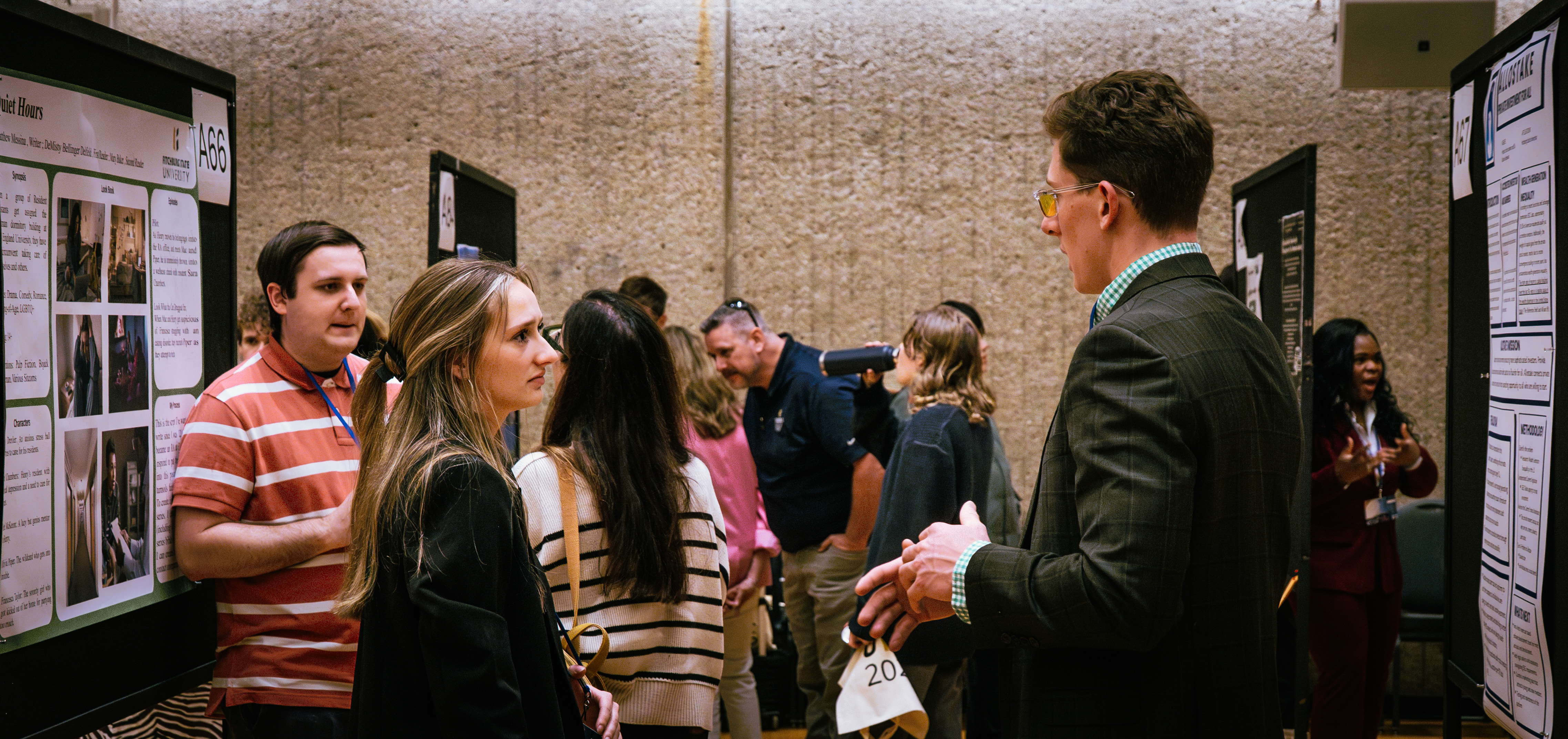
Faculty Sponsor: DeMisty D. Bellinger-Delfeld
School: Fitchburg State University
Research Area: Literature
Location: Poster Session 3, 1:15 PM - 2:00 PM: Campus Center Auditorium [A45]
I write on this subject because the first 'Jurassic Park' novel by Michael Crichton inspired in me an interest in cloning, and I found the de-extinction of the dire wolves to be an excellent reason to discuss the power one should have over biology. Naturally, I am also inspired heavily by Mary Shelley's 'Frankenstein.' However, 'Tomorrow's Prometheus' deviates from its sources of inspiration by the fact that it warns of corruption's ability to enter circles designed to prevent it from becoming a genuine threat to society.
Faculty Sponsor: DeMisty D. Bellinger-Delfeld
School: Fitchburg State University
Research Area: Literature
Location: Poster Session 3, 1:15 PM - 2:00 PM: Campus Center Auditorium [A46]
Cain’s Jawbone is a murder mystery book published in 1934, written by puzzle writer Torquemada. Within the 100 pages, six different characters are killed and it is up to the reader to solve who killed each of them. The catch is that the 100 pages of the book are printed out of order and in order to solve the murders, you must first rearrange all of the pages and figure out their correct order. Only then can you identify the six victims and each of their murderers. Between its publication in 1934 and 2020, only four people had successfully solved it. Within the past six years, more people have solved the mystery and I aim to become a member of this unofficial club of people who have correctly solved the puzzle.
Using the skills of analysis, writing, and research I have learned as an English major, my project will document my steps and research in my attempt to figure out the puzzle and put together the correct solution. These skills will help me be able to connect writing styles between narrators and chapters, identify allusions and literary references throughout the text, and pick up on the hidden clues needed to solve the puzzle.
Faculty Sponsor: Trevor Kearns
School: Greenfield Community College
Research Area: Literature
Location: Poster Session 4, 2:15 PM - 3:00 PM: Campus Center Auditorium [A70]
This project explores how children’s literature can shape a child’s perception of creativity, beauty, and the natural world. My 32-page fully illustrated book, God Painted the Sky, encourages young readers to view creation as an intentional work of art. The project was inspired by the question of how storytelling and visual design can cultivate wonder and attentiveness in children rather than passive consumption of images and narratives.
Drawing on narrative and illustration techniques studied in ENG 241 (Children’s Literature), I crafted a story that combines lyrical language, repetition, and sensory imagery to make abstract ideas accessible to early readers. The book’s structure follows a gentle, reflective progression that mirrors a child’s curiosity about the sky and surrounding environment. The illustrations are fully integrated with the text, using color, scale, and perspective to reinforce emotional tone.
A key component of the visual design incorporates the psychology of darkness and snugness. Research on children’s media suggests that dim lighting, enclosed spaces, and warm tones evoke feelings of safety and intimacy. By placing expansive depictions of the sky within cozy visual frames, the book creates an emotional balance between comfort and awe.
Ultimately, this project demonstrates how intentional literary and artistic choices can shape emotional engagement and meaning-making, highlighting the formative power of children’s literature in shaping imagination and perception.
Faculty Sponsor: Scott Aaron Nowka
School: Salem State University
Research Area: Literature
Location: Poster Session 4, 2:15 PM - 3:00 PM: Campus Center Auditorium [A71]
Robinson Crusoe by Daniel Defoe is widely considered the first English novel and the most influential castaway story in literary history. Defoe’s detailed, rambling narrative style can be found across many of his works and often offers an opportunity for his readers to enter the unique minds of his characters. The title character of Robinson Crusoe takes control over the island that he has been stranded on and asserts himself as the dominant figure in his dynamic with his sole companion, Friday. Crusoe finds no fault in his actions throughout his narrative, describing them to his audience as necessary and natural as the plot goes on. Crusoe is often guided by his religious beliefs and states his observations of the world as being based in fact rather than opinion. His perspective is provided as the only perspective to have with no room for disagreement from the audience. Despite this, his actions are brought to question by many literary scholars and critics. His behaviours are commonly categorised as colonialist and the nature of his relationship with Friday is questioned as not being as mutually beneficial as he let on. In connection to these preexisting conversations, I will consider how Crusoe’s new-found and inconsistent religion may be used to justify his control over Friday and how religion plays a role in minimising his colonial actions.
Faculty Sponsor: Anupama Arora
School: UMass Dartmouth
Research Area: Literature
Location: Poster Session 4, 2:15 PM - 3:00 PM: Campus Center Auditorium [A72]
Faculty Sponsor: Zachary Finch
School: Massachusetts College of Liberal Arts
Research Area: Literature
Location: Poster Session 4, 2:15 PM - 3:00 PM: Campus Center Auditorium [A74]
I propose to present my ongoing Commonwealth Honors Thesis, an autotheoretical essay that considers the aesthetic and sociopolitical components of so-called “transgressive fiction” in the works of Marquis de Sade, Georges Bataille, and Kathy Acker. Employing literary criticism, psychoanalysis, autofiction, and the theories of transgression and taboo set forth by Georges Bataille and Michel Foucault, the thesis explores fiction that, on the level of both form and content, infringes on social and political limits and operates from the edges of physical and psychic experience. Through my autotheoretical approach, I utilize my experience with sexual violence to examine the aesthetic value and impact of the novels of Sade, Bataille, and Acker, applying Avgi Saketopoulou’s theory of traumatophilia to describe why one might (and why I do) feel drawn to and thrilled by work that pushes the boundaries of what is “supposed” to be written about and how. Ultimately, I want to provide a creative, multi-disciplinary evaluation of the role that taboo-centered literature plays in the lives of writers and readers, and the myriad, sometimes conflicting, ways that this literature might interact with histories (whether individual or collective) of sexual violence and trauma.
RELATED ABSTRACTS
- Responding to the Revised Sexual Experiences Survey: A Qualitative Content Analysis of Participant Experience, Kamrad, Addison Lynn, Worcester State University, Poster Session 2, 11:30 AM - 12:15 PM, Concourse, B3
- This is Why I Left: Sexual Violence Fuels Migrants’ Decision to Move to the United States, Kola, Andja, Worcester State University, Poster Session 2, 11:30 AM - 12:15 PM, Concourse, B1
- Tortured by Culture: An Epistemology of Intense Violence in the United States of America, Baxter, Nicholas C., UMass Amherst, Poster Session 5, 3:15 PM - 4:00 PM, Auditorium, A66
Faculty Sponsor: Raúl D. Gutiérrez
School: Holyoke Community College
Research Area: Literature
Location: Poster Session 5, 3:15 PM - 4:00 PM: Campus Center Auditorium [A71]
In today’s modern era, art has been increasingly ridiculed, devalued, and trivialized, through developments like A.I. and the cultural discourse on the commodification of art. This paper will primarily focus on Mosab Abu Toha’s poetry as a fundamental medium of action within the Palestinian cause. About 18 months before Israel commenced their genocidal campaign in Gaza, Mosab Abu Toha, a Palestinian poet and scholar, wrote and published a collection of poems, titled Things You May Find Hidden in My Ear. Within this body of work, he details the horrors and pains of daily life in the Gaza strip, and communicates themes common within Palestinian poetry, such as sumud, the right of return and Palestinian self-determination. These sentiments were inherited by the generations that came after the mass murder and expulsion of Palestinians in 1948. Through lines on the anguishing sound of silence to the harrowing imagery of mass graves, we can observe that Mosab’s writings follow the legacy of Israeli settler-colonialism. This depicts the nature of liberation literature, which goes beyond the traditional study of liberatory struggle by confronting the external struggle through an internal route. Like Paulo Freire, Assata Shakur, Toni Morrison, Mahmoud Darwish and many others, Mosab explores the emotional and spiritual freedom of Palestinians, while archiving historical accounts and celebrating Palestinian resilience.